Paraxanthine:
Caffeine's Active Metabolite
Paraxanthine is what your body actually converts caffeine into. Supplementing it directly skips that conversion step — here's the research on what that changes, the real clinical dosing, and where it's used in the Unmatched lineup.
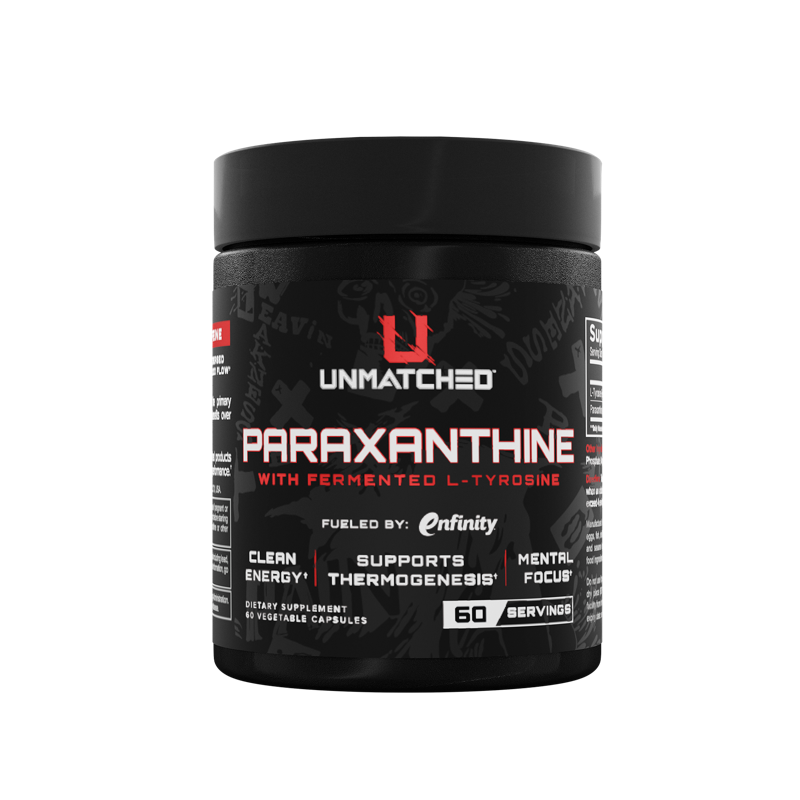
What Is Paraxanthine?
Paraxanthine (1,7-dimethylxanthine) is a naturally occurring xanthine alkaloid and the primary metabolite of caffeine. When you consume caffeine, your liver breaks it down into three main byproducts: paraxanthine (roughly 84% of the dose), theobromine (~12%), and theophylline (~4%). Paraxanthine is the dominant one — and it's largely responsible for the alertness and focus effects people associate with caffeine in the first place.
Supplementing with paraxanthine directly means skipping that conversion step. Instead of taking caffeine and waiting for your liver to turn a portion of it into paraxanthine, you take the metabolite itself. The patented, clinically studied form used in supplements is enfinity®, licensed by Ingenious Ingredients — the version dosed in BH2K, and the form used in most of the human research cited below.
How It Works
Like caffeine, paraxanthine's primary mechanism is adenosine receptor antagonism — blocking the receptors that build up "sleep pressure" over the course of a day, which is what produces the alertness effect both compounds share. That shared mechanism is why paraxanthine "feels like" caffeine rather than something unrelated.
Where it differs is clearance and, in some of the newer research, a second pathway: paraxanthine also appears to inhibit the PDE9 enzyme, a mechanism caffeine doesn't meaningfully engage, which some researchers link to the memory and neuroplasticity effects discussed below. Paraxanthine's half-life runs roughly 3-4 hours, versus roughly 5-6 hours for caffeine (both vary by individual metabolism — notably CYP1A2 genotype). That shorter window is the mechanical reason behind most of the practical differences people report: less overshoot into jitteriness, less carryover into a late-evening sleep window, and a comedown that reads as leveling off rather than crashing.
What the Research Shows
Comparable Alertness, Shorter Half-Life
Same core adenosine-blocking mechanism as caffeine, but clearing the body faster — the basis for the cleaner-comedown and lower-sleep-disruption reports from users.
Cognitive Performance
A 2024 trial in the Journal of the International Society of Sports Nutrition (Yoo et al.) found paraxanthine produced greater improvements in cognitive function and psychomotor vigilance than caffeine after a 10-km run.
Memory & Neuroplasticity
A 2025 study in Experimental Brain Research (Jäger et al.) attributes stronger memory consolidation and neuroplasticity effects to paraxanthine's PDE9 inhibition — a pathway caffeine doesn't engage.
Lower Reported Jitteriness
The shorter half-life is consistent with the lower rates of jitteriness and anxiety reported at matched stimulant doses versus caffeine, though this area still needs more independent replication.
Paraxanthine vs Caffeine: The Comparison
| Factor | Paraxanthine | Caffeine |
|---|---|---|
| Half-life | ~3-4 hours | ~5-6 hours (varies by genetics) |
| Core mechanism | Adenosine receptor antagonism | Adenosine receptor antagonism |
| Secondary pathway | PDE9 inhibition (early research) | None established |
| Jitters/anxiety | Lower reported rates | Common, dose-dependent |
| Sleep impact | Clears faster, less carryover | Longer tail into evening |
| Research base | Smaller, growing | Decades of research |
Half-life ranges are approximate and vary by individual metabolism. This is general information, not medical advice.
Clinical Dosing
Human trials on enfinity® paraxanthine have generally used doses in the 100-400mg range. BH2K doses it at 300mg per scoop as its primary stimulant, in place of caffeine anhydrous — a dose inside the range used in the published research rather than a token or underdosed amount. Unmatched also sells paraxanthine as a standalone product for anyone who wants to dose it separately from a full pre-workout formula, or stack it with a stim-free pump product.
As with any stimulant, individual tolerance varies. If you're new to paraxanthine, judging your response at a single serving before combining it with other stimulant-containing products (coffee, other pre-workouts) is the sensible approach — the same rule that applies to caffeine.
The Studies
Yoo et al., 2024 — Journal of the International Society of Sports Nutrition: Paraxanthine produced greater improvements in cognitive function and psychomotor vigilance than caffeine after a 10-km run, with better prefrontal cortex performance and less attentional decline.
Jäger et al., 2025 — Experimental Brain Research: Paraxanthine enhanced memory consolidation and neuroplasticity more effectively than caffeine in controlled testing, an effect the authors attribute to PDE9 enzyme inhibition — a pathway caffeine doesn't meaningfully engage.
Paraxanthine's research base is smaller than caffeine's simply because caffeine has a multi-decade head start. The direction of the findings so far is consistent, but the sample sizes are still modest and further independent replication — not funded by the ingredient's patent holder — is exactly what this research base needs next.
Frequently Asked Questions
Is paraxanthine safe?
Paraxanthine is the primary metabolite of caffeine — your liver produces it naturally every time you drink coffee — and the enfinity® form used in supplements has been through human clinical trials at doses up to 300mg. As with any stimulant, check with a doctor first if you're pregnant, nursing, sensitive to stimulants, or on medication.
How much paraxanthine should I take?
Clinical research on enfinity® paraxanthine has used doses in the 100-400mg range. BH2K doses it at 300mg per serving, in the range used in the published trials rather than an underdosed amount.
Can I stack paraxanthine with other supplements?
Yes. In BH2K it's already stacked with beta-alanine, L-citrulline, L-tyrosine and acetyl-L-carnitine — a standard pre-workout combination. There's no known interaction that makes paraxanthine unsafe to combine with creatine, EAAs, or a protein shake.
Will paraxanthine show up on a drug test?
No. Paraxanthine is not a banned or controlled substance and won't trigger a standard drug test — the same way caffeine (which your body converts partly into paraxanthine anyway) doesn't.
Is paraxanthine better than caffeine?
It depends what you're optimizing for. Paraxanthine has a shorter half-life than caffeine, which in practice means less carryover into your sleep window and a cleaner comedown for a lot of people — but caffeine is cheaper, more available, and works fine for anyone who already tolerates it well. See the comparison below.
Which Unmatched product has paraxanthine, and at what dose?
BH2K pre-workout uses 300mg of enfinity® paraxanthine per scoop as its primary stimulant, in place of caffeine anhydrous.
Try Paraxanthine in BH2K
300mg of enfinity® paraxanthine per scoop, dosed in the range used in the published research — not a token amount.
Shop Unmatched SupplementsUse code STEVEN10 for 10% off + free shipping on orders over $150
10% off any order at unmatchedsupps.com. Stacks with sitewide sales. Never expires.
STEVEN10 is the standing 10%-off code for every Unmatched Supplements order — see the full breakdown, current deals, and checkout steps on the STEVEN10 promo code page.